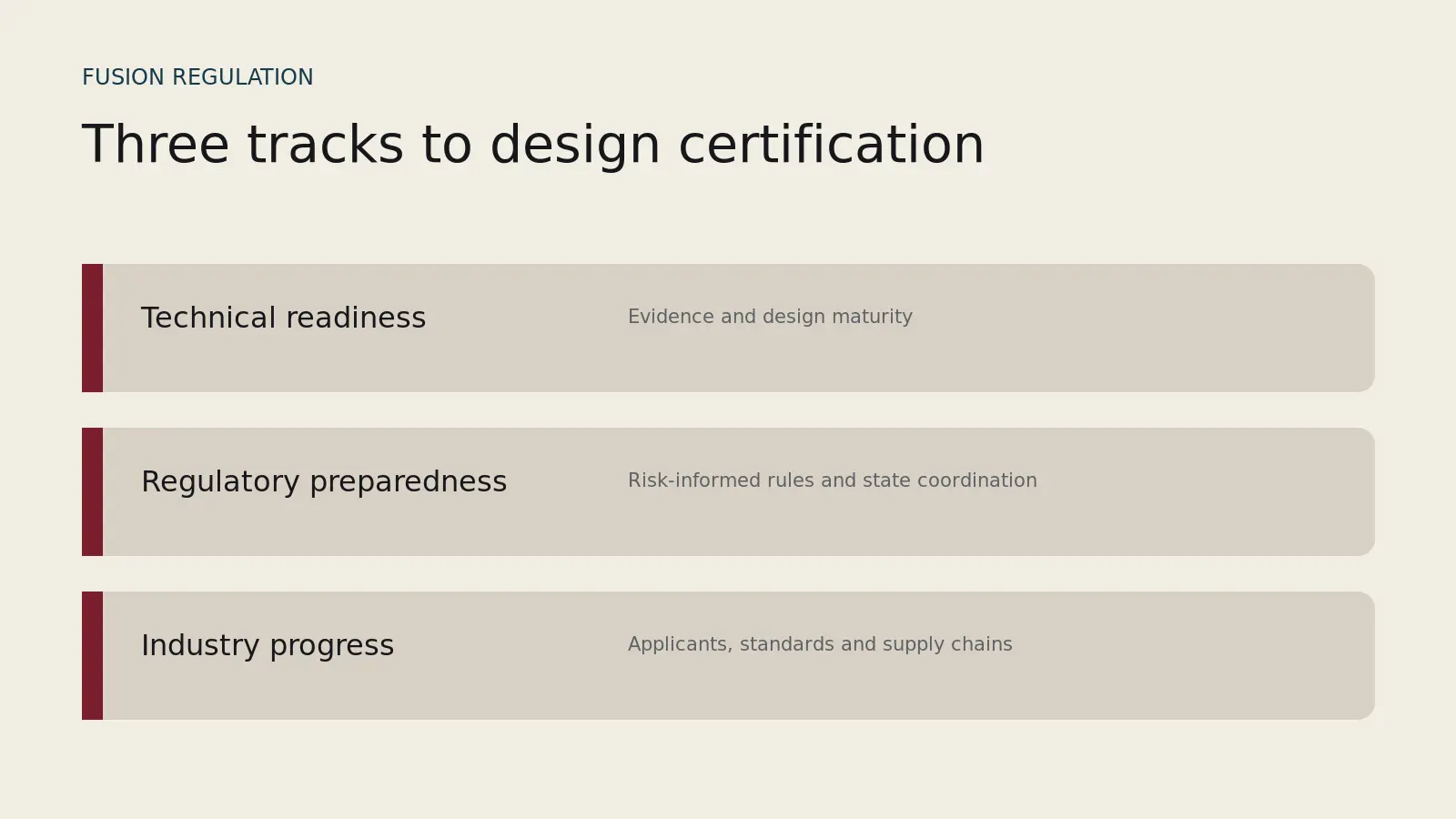
Fusion policy should choose safety, evidence and speed while leaving reactor architecture to technical competition.
Public policy must make choices. It must decide how much foundational research to fund, how to regulate hazards, how to share first-of-a-kind risk and where to build public infrastructure. It need not decide which fusion machine will ultimately win.
A technology-neutral framework establishes demanding outcomes while allowing competing technical pathways to meet them. It is compatible with rigorous safety. In fact, risk-informed regulation becomes more credible when it evaluates the actual characteristics of a system rather than inheriting assumptions from a different technology.
Neutrality should not become an excuse for passivity. Shared test facilities, milestone-based programs, materials research and workforce development require active public investment. Clear licensing pathways require institutional preparation before developers arrive at the door.
Nor should neutrality mean equal treatment of unequal evidence. Public programmes can apply common gates for measurement quality, safety analysis, cost assumptions and retirement of system risk. Concepts that clear them should receive more support; those that repeatedly miss them should receive less. Competition needs consequences to remain informative.
The most useful portfolio separates architecture-specific bets from enabling assets. A blanket test facility, materials database or trained regulator can retain value when a reactor design fails. Funding both categories allows government to tolerate technical diversity without scattering every dollar evenly.
Government should be bold about building the field and modest about predicting its final architecture.